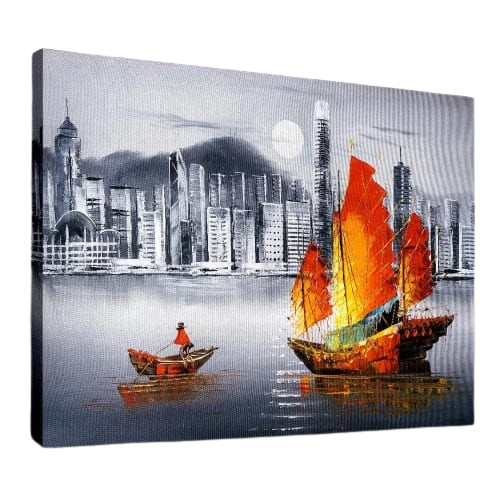
The first time I bought a canvas frame, I thought I understood exactly what I was getting. The photos online looked clean, modern, almost effortless. When it arrived, it looked good, until about four months later when the corners started to loosen slightly and the surface lost that tight, crisp tension it had at the beginning. That was the moment I realized something most articles don’t tell you: understanding canvas frames is less about definitions and more about how they behave in real spaces, over time.
This isn’t a theoretical guide. It’s based on how canvas frames are actually made, how they perform in environments like ours, and the kind of issues framers and print shops quietly warn you about if you ask the right questions.
Let’s start from the ground up.
What a canvas frame actually is
A canvas frame is not just a “frame” in the traditional sense. It’s a structural system. At its core, you have a fabric (usually cotton or a cotton-poly blend) stretched tightly over a wooden support structure called stretcher bars. The image is either printed directly onto the canvas or painted by hand, and then the material is pulled tight and stapled at the back.
That tension is everything. It’s what gives canvas its flat, drum-like surface. If the tension is off, even slightly, the entire piece looks cheap.
In most cases, what people call a “canvas frame” falls into one of two categories:
First, the stretched canvas itself. This is the frameless look where the image wraps around the edges. It’s what you see in most modern homes and offices.
Second, the floating frame. This is an outer frame that surrounds the stretched canvas but doesn’t press against it. There’s a small gap that creates a shadow line, making the artwork appear suspended. When done properly, it elevates the piece. When done poorly, it exposes every flaw in alignment and construction.
What matters more than the type is how it’s made. In Nigeria, especially, there’s a wide gap between what’s sold cheaply online and what comes out of dedicated print studios or framing workshops. The difference usually comes down to three things: the wood, the canvas quality, and the tensioning process.
Good stretcher bars are kiln-dried to reduce warping. Cheaper ones are often just cut wood that still contains moisture. That moisture eventually escapes, and when it does, the wood bends. When the wood bends, the canvas loosens. That’s when you start seeing ripples on the surface.
I’ve seen this happen in less than six months.
What a canvas frame is not
This is where most confusion, and disappointment, comes from.
A canvas frame is not a protective enclosure. There is no glass. There is no acrylic. The surface is exposed. That means dust settles directly on the print, and if something scratches it, there’s no barrier to absorb the damage.
It is also not equivalent to a traditional framed photograph. A photo frame is designed to preserve. A canvas frame is designed to present.
That difference matters more than people think.
If you hang a family portrait in a glass frame, it can last decades with minimal change. The same image printed on canvas and placed in direct sunlight can start fading within a couple of years, depending on the ink quality.
It is also not maintenance-free. This is one of the biggest misconceptions. People assume canvas is “set and forget.” In reality, it responds to temperature, humidity, and handling.
In humid regions, like much of southern Nigeria, the canvas can absorb moisture from the air. Over time, that softens the tension. You’ll notice it when you lightly press the surface and it no longer feels firm.
Professional framers will tell you this upfront if you ask. Many even include small wooden keys (called wedges) in the corners of the stretcher bars. These are there so you can re-tighten the canvas when it loosens. Most buyers don’t even know what those pieces are for.
The advantages of canvas frames (when they’re done properly)
There’s a reason canvas frames are everywhere now. When they’re made well and used in the right setting, they do things traditional frames can’t.
The first is visual depth. Canvas has a texture that interacts with light differently from paper. Even a printed image feels more dimensional because of the slight weave in the material. It’s subtle, but once you notice it, flat prints start to look lifeless by comparison.
The second is weight. A large glass frame can be heavy and risky to hang, especially on weaker walls. Canvas frames are significantly lighter. That makes them easier to install and safer in spaces where you don’t want the risk of glass breaking.
The third is glare reduction. In rooms with a lot of natural light, glass frames reflect everything, windows, bulbs, movement. Canvas eliminates that completely. What you see is the image, not reflections layered over it.
The fourth is aesthetic flexibility. Canvas works well in contemporary interiors. It blends into minimalist spaces without looking overdesigned. Interior designers often choose it because it doesn’t compete with other elements in the room.
But here’s the part most blogs skip: these advantages only show up when the production quality is high.
I’ve compared two canvas prints of the same image—one from a low-cost online seller and one from a specialized print studio. The cheaper one looked fine at first glance, but up close, the difference was obvious. The colors were flatter, the edges weren’t perfectly wrapped, and the surface tension wasn’t consistent.
The higher-quality one had sharper detail, tighter stretching, and better color accuracy. It felt like an object that would last, not just something decorative.
That difference is what you’re paying for.
The disadvantages (and the ones that actually matter)
This is where trust is usually lost in most articles. The disadvantages are either softened or treated as minor. They’re not.
The biggest issue is exposure.
Canvas has no protective layer by default. Dust accumulates. Smoke, kitchen residue, and humidity all affect the surface over time. Cleaning it is not straightforward. You can’t just wipe it like glass. Too much pressure or moisture can damage the print.
Then there’s environmental sensitivity.
If you live in a humid area and your room is not well-ventilated, the canvas will eventually react. It may not happen immediately, but it will happen. The tension drops, and the surface begins to sag slightly.
I’ve seen this in apartments where the canvas looked perfect for the first few months, then slowly lost its firmness. It doesn’t collapse, it just stops looking premium.
Another issue is fading.
Not all inks are equal. Professional studios use archival inks designed to resist UV damage. Cheaper prints use standard inks that degrade faster. If your canvas is placed opposite a window or in direct sunlight, the difference becomes obvious within a year or two.
There’s also the problem of structural quality.
Low-grade stretcher bars are one of the most common failure points. If the wood is not properly dried or cut, it warps. Once it warps, the entire canvas distorts. At that point, fixing it is difficult.
Finally, there’s the expectation gap.
Many people buy canvas frames expecting them to feel like luxury items regardless of price. But canvas is very sensitive to production quality. A poorly made one doesn’t just look slightly worse, it looks noticeably cheaper.
Why most people get it wrong when buying canvas frames
The mistake is usually the same: people judge based on the front image alone.
They don’t check the back. They don’t ask about the wood. They don’t ask what type of canvas is used or whether the ink is archival. They assume all canvas prints are essentially the same.
They’re not.
Specialized print and framing stores, especially the ones that focus on photography, art reproduction, or interior décor, tend to be more transparent about these details. If you walk into one and ask how their canvas is stretched or what wood they use, you’ll usually get a clear answer.
That alone tells you something about the product.
In contrast, many mass-market listings don’t provide that information at all. The focus is on the image, the size, and the price. The construction details are missing, and those are the details that determine whether the piece still looks good a year later.
How to tell if a canvas frame is worth buying
You don’t need to be an expert. You just need to check a few things.
- Look at the corners. They should be tight and clean, not bulky or uneven.
- Press lightly on the center. It should feel firm, not soft or spongy.
- Check the back. The staples should be neat, and the canvas should be evenly stretched.
- Ask about the wood. If the seller can’t tell you what kind of stretcher bars are used, that’s a red flag.
- Ask about the ink. If it’s not described as archival or fade-resistant, assume it’s standard.
These small checks eliminate most low-quality options immediately.
The bottom line
Canvas frames are not inherently better than traditional frames. They serve a different purpose.
They are designed for visual impact, not protection. They excel in modern spaces, controlled environments, and situations where you want the artwork to feel integrated into the room rather than enclosed.
But they demand more awareness from the buyer.
If you choose based on appearance alone, you’ll likely be disappointed over time. If you pay attention to construction, materials, and placement, a canvas frame can hold its quality for years.
The difference between those two outcomes isn’t luck. It’s understanding what you’re actually buying.
That’s the part most articles leave out, and the part that determines whether a canvas frame feels like a good decision or a wasted one.